With every Soma Analytics account
What onboarding answersHow do I run Soma?Setting up the account, creating athletes, building sessions, delivering them, finding the results. Enough to get your first athlete training this week.
Looks like you’re on mobile. To create your Soma account, head to a desktop or laptop to get started.
This is not a course on how to operate the platform. That part is onboarding, and it is free with every account. This is the practice behind it: what the numbers mean, how to tell a real change from noise, how to load the brain on purpose, and how to build a programme that still makes sense in week twelve.
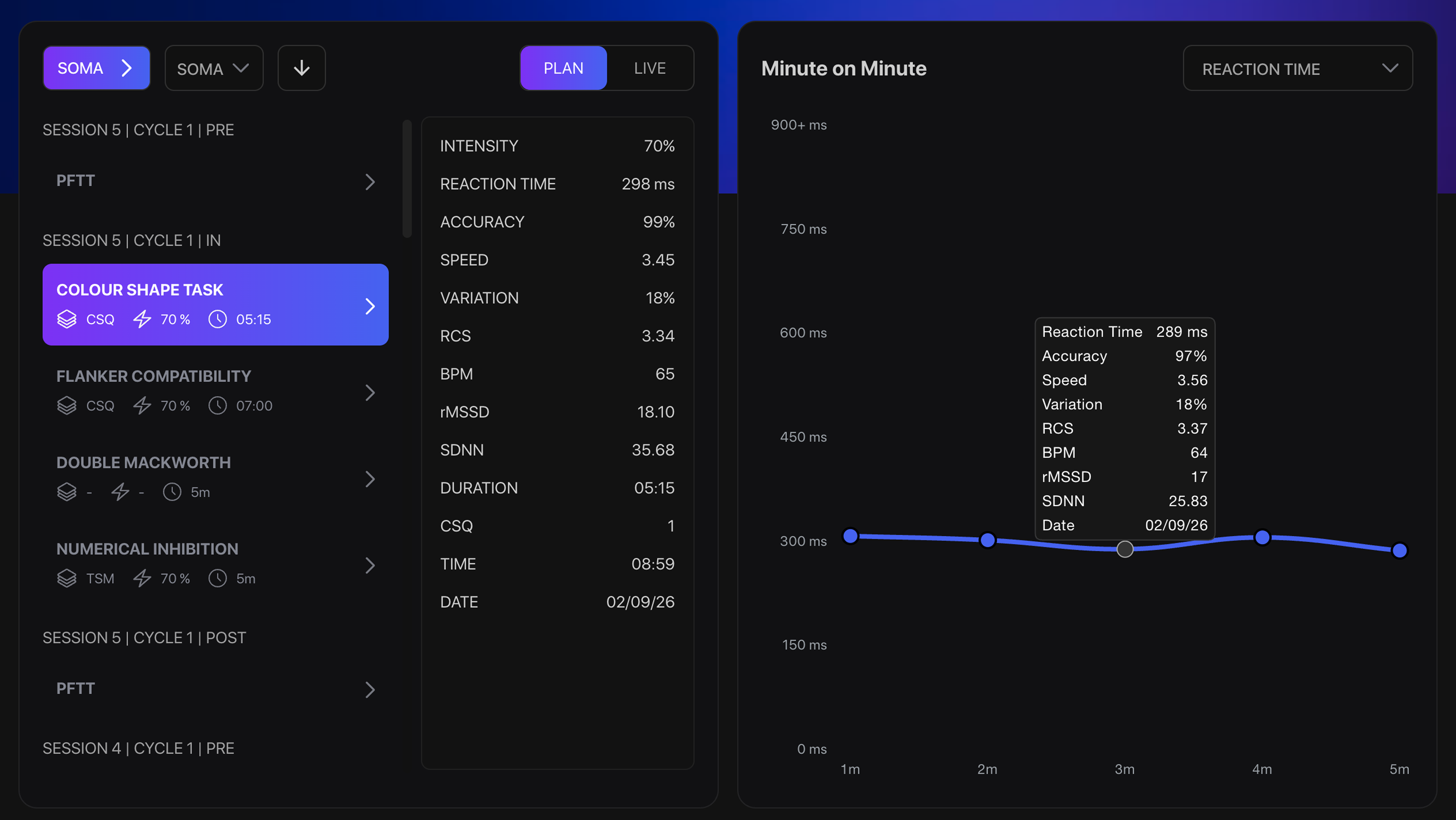
Most coaches get set up quickly. Sessions go out, athletes complete them, data comes back. Then the harder question arrives: the number moved, so what now? Onboarding gets you running the platform. This course is about the decision you make once the results are in front of you.
With every Soma Analytics account
What onboarding answersHow do I run Soma?Setting up the account, creating athletes, building sessions, delivering them, finding the results. Enough to get your first athlete training this week.
Once, or 550 CHF a month for 12 months
What the course answersThe reaction time dropped and the variation went up. What do I change?This is the coaching question, and no dashboard answers it for you. Twenty sections on reading the data, loading the brain deliberately, and programming the next block from what you found.
Normally 99 CHF a month. Yours once you certify.
What the Hub answersWhat changed since I certified?New material every week, research updates translated into practice, community Q&A, and coaching tools built for Soma.
Two halves. Soma Analytics is where you build the plan and read what came back. Soma NPT is what the athlete opens on an iPhone or iPad and trains in. The course is not a tour of either. It is what to do with the numbers they produce.
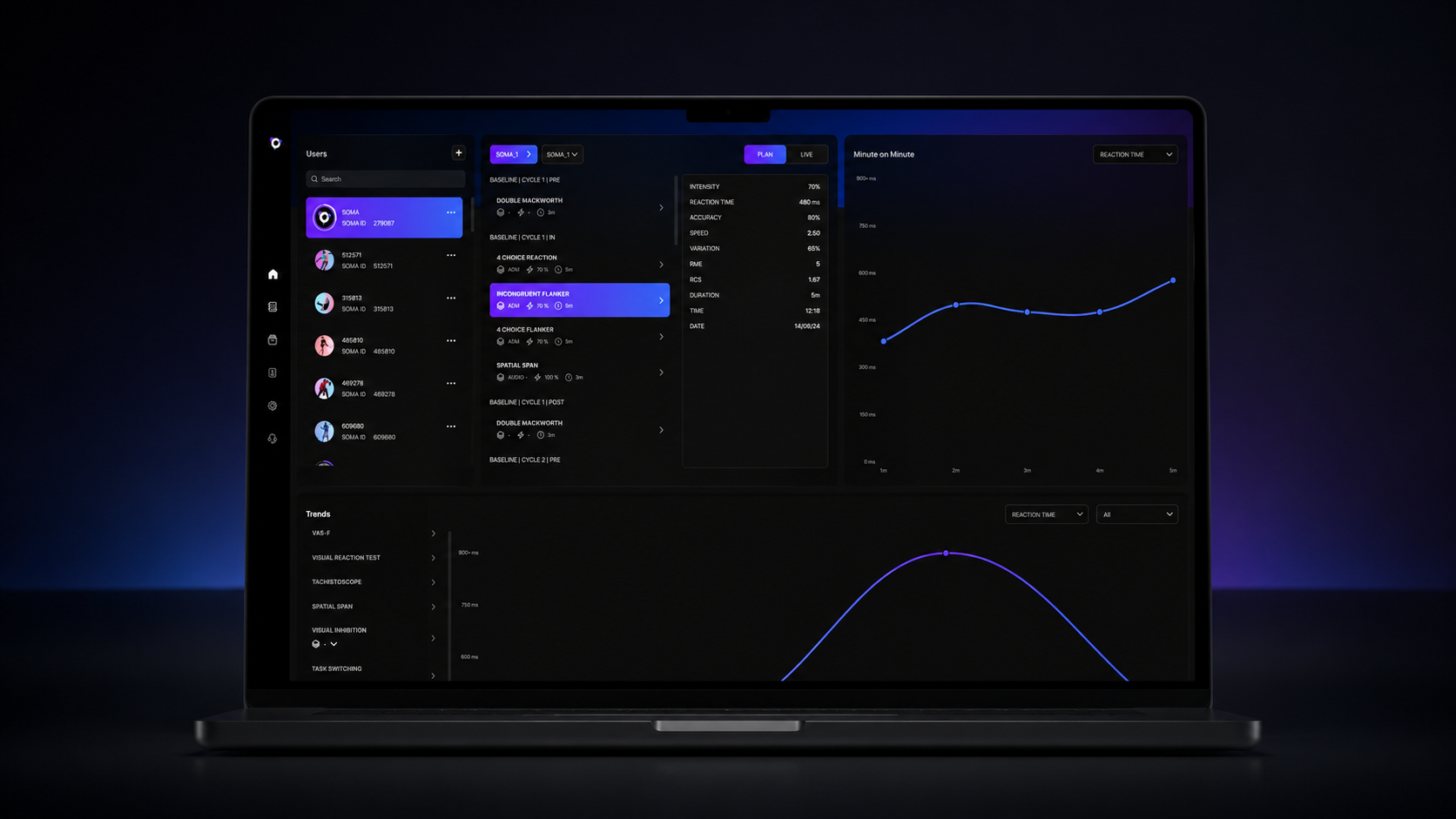
Build sessions and blocks, apply modes, and read every result against the athlete's own baseline. Mean and minute on minute for all seven metrics, trends across a block, and the comparisons that tell you whether the plan is working.
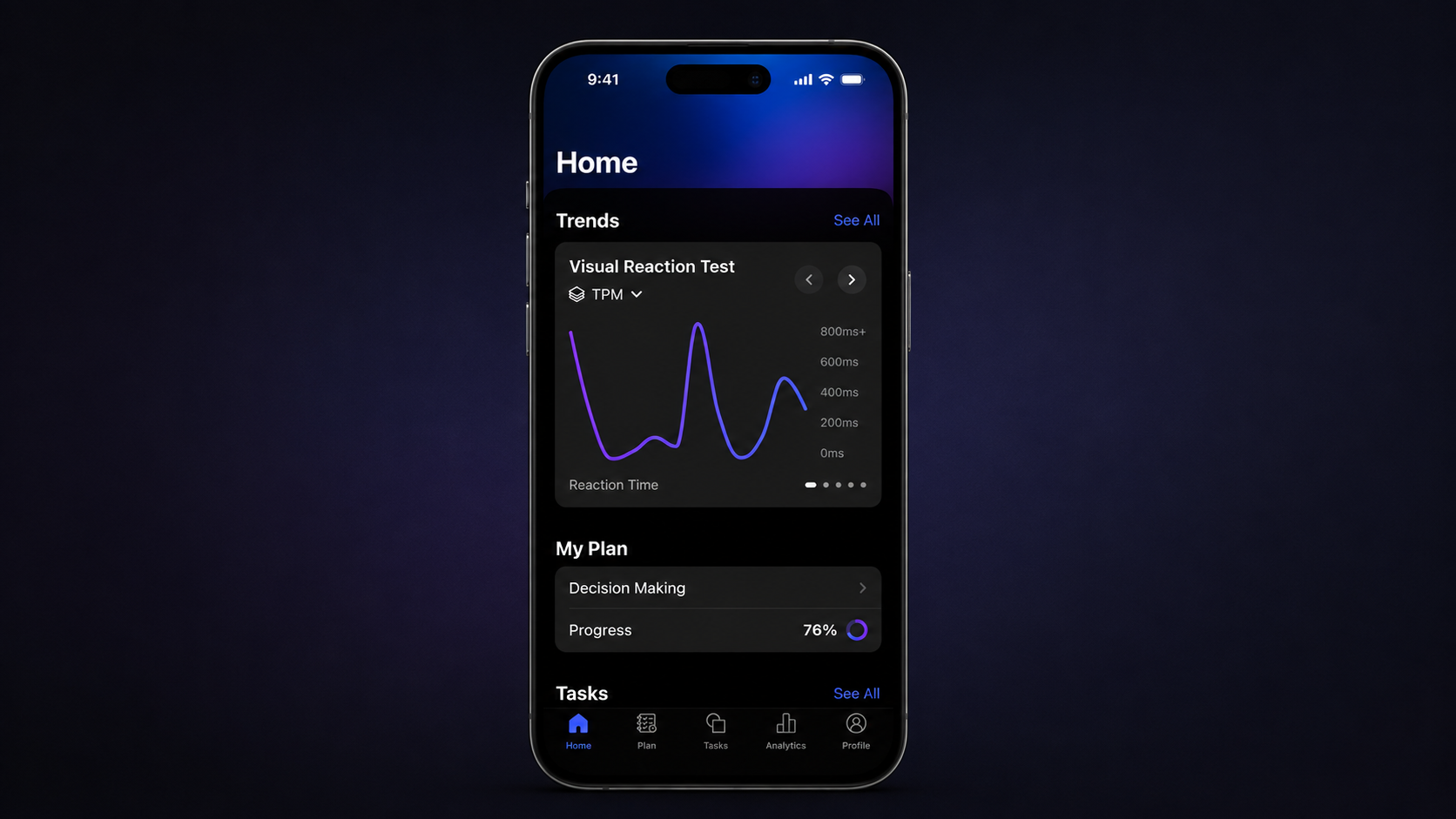
The athlete opens the session you built, trains, and the data lands back in your dashboard within seconds. It works anywhere, so the programme holds through travel, camps and the off-season.
Four separate things. Twenty sections of material. Sixty-five built programmes in your account from day one. An hour of one-to-one coaching at the end of it. And lifetime access to the Hub, where the research updates and new material land every week.
Twenty sections, sixty-nine lessons
Not an overview. Every metric gets its own lesson. So does every mode, every monitoring tool and every placement method.
 Seven metrics, each with its own sectionMean against minute on minute, and why both are neededThree tools for measuring mental fatigueFour ways to place cognitive work in a sessionFifteen modes, one dedicated lesson eachFour cognitive demands and how to find the weak oneBaselines, blocks, ratios and periodisationGame week, from three days out to the day afterCritical-thinking scenarios from real coaching situationsFlow charts for the decisions you make mid-week
In your account from the day you sign up
Complete blocks, already built and already periodised, loaded straight into Soma Analytics. You do not have to finish the course to start using them.
Run them as they are, from your first sessionAdapt them to a sport or an individual athleteTake them apart to see how the periodisation was builtTasks, modes and progressions already setCovering all four cognitive demandsStructures for off-season, pre-season and in-seasonThe reference point when you start building your ownLoaded straight into your account, nothing to importOne to one, at the end of the course
Not a lesson and not a sales call. An hour of coaching on your setup, with everything you have picked up across the twenty sections in front of you. Booked when you are ready, not on a fixed date.
Anything from the course you want gone over againYour account setup, reviewed end to endIndividual athletes and their dataYour baseline structure, before you commit to itThe first training block you have builtThe implementation questions the lessons did not coverNormally 99 CHF a month. Yours for good once you certify.
The course teaches you the system as it stands today. The Hub is how you stay current as the research moves, and it is the single biggest thing you walk away with.
New material every week, research updates translated into practice, community Q&A, and coaching tools built for Soma.Research updates translated into coaching practiceMini courses on cognitive data and commercial applicationA growing resource library for every stage of a practiceCommunity Q&A with other Soma professionalsAI coaching tools built specifically for Soma coachesNew modes and methods as they are releasedCertification is the paperwork. These are the reasons to sit the course.
Two athletes post the same mean. One held their level all session, the other started sharp and fell apart by minute five. Reading the average alone, they look identical. You learn to see the difference in about thirty seconds.
One session is noise. Weeks one and two of any block look chaotic, and that is the process rather than a fault in the plan. You learn when to hold your nerve and when the data is genuinely telling you to change something.
Athletes who have carried fatigue for months lose the ability to feel it. They will tell you they are fine. You learn to check that against something objective, and what to do when the two disagree.
Four ways to place cognitive work in a session, each producing a different outcome, each with a season it belongs in. Plus the dose below which nothing meaningful happens, whatever the task.
Fifteen modes, each with its own lesson, its own signal in the data, and its own point in the year. There is a sequence to introducing them, and getting it wrong costs you a block.
Baseline, build, periodise, analyse, build again. Progressive and undulating, one lever at a time, plus how to taper cognitive load into a game and restore it afterwards.
Almost every mistake coaches make with cognitive training comes from chasing a better score on a task instead of managing the load underneath it, and a good part of this course is spent on that distinction.
It is also why you do not need to keep hunting for the right drill. A task the athlete has solved produces nothing, however clever it is. The same task with load applied properly keeps producing adaptation for a whole block.
The full list, in the order you work through it. Every section is named, so you know exactly what you are buying before you buy it. Open a block to see the sections inside it.
Seven metrics, the two ways to read every one, and how to tell a real trend from a bad Tuesday.
Two ways to look at the same session
How fast is the brain processing?
Making small improvements visible
Reading consistency across a session
Speed and accuracy in one number
What errors tell you that speed does not
Reading readiness before you load the athlete
Whether the current load can be held long term
Reading a trend, plus flow charts for mean metrics, minute on minute and all seven metrics
PVT-B, PFTT and the RMF scale, and what to do when they disagree with each other.
Why mental fatigue is invisible without measurement. The PVT-B as your primary monitoring tool, the PFTT for the cognitive breaking point under physical stress, and the RMF scale for when perception and data disagree.
Four ways to place cognitive work in a session, and fifteen modes controlling the load inside it.
How to put cognitive training into a session, the minimum effective dose, the four integration methods, what to train against the baseline, and how to periodise load around game day.
A dedicated lesson for every mode, when to introduce each one, and how to sequence them so the brain keeps adapting.
Baseline, block, review, progress. Game week, periodisation, and an hour on your own setup.
Cognitive demands, the baseline, and why the task is the vehicle while the load is the stimulus.
The five-step loop from baseline to block, and priming against training for activating the brain before competition.
Fresh against fatigued baselines, the bookend strategy, tracking the threshold with PFTT inside a strength session, advanced mode combinations, and what a year of sessions actually looks like.
Scenario-based questions from real coaching situations. Separating meaningful patterns from noise and making decisions that hold up under scrutiny.
Mean metrics, minute on minute, and all seven metrics.
PVT-B, PFTT, and all three performance tools.
The four integration methods, how the season shapes the method, and the planning loop.
Review your setup and individual athletes, answer implementation questions, review the first training block and clarify baseline structure.
One dedicated lesson each: the effect it produces, where it belongs, how it combines.
Shaping behaviour through immediate feedback
Training recovery speed after mistakes
Making errors cost something
Measuring what the brain has left in reserve
Finding and extending the endurance limit
Building response rhythm
Keeping the challenge permanently at the edge
Cognitive training under physical pressure
Heart rate as the gate
Staying sharp as intensity changes
Load that adjusts to the nervous system
Managing two demands at once
Making concentration lapses visible
When errors cost physical effort
Decision speed under a closing window
Each section builds on the last. By Section 12, you’ll be applying the variation-curve skills introduced in Section 04. You can complete the course in one focused week, or take several weeks to apply each section with your own athletes as you progress.
Sixty-nine lessons across twenty sections. Short, one idea each, in a sequence that goes from the single metric outward to the season.
Quizzes throughout, plus a critical-thinking section built from real coaching situations where the data does not point one clean way.
For mean metrics, minute on minute, all seven metrics, the performance tools and the integration methods. Made to be used mid-week.
Lifetime access to all twenty sections, and lifetime Hub access once you certify. Whichever way you pay, access starts today. You do not need a Soma account first: the 65 templates load in as soon as you have one.
Paid once, and that is the whole cost. All twenty sections open immediately, the 65 templates load into your Soma Analytics account, your private hour is booked when you are ready for it, and the Hub is yours for life.
Take the courseTwelve payments, 6,600 CHF in total. Spreading it costs more than paying up front, and the course, the certification, the templates, the private hour and lifetime Hub access are identical either way.
Start the 12 month planBoth go straight to checkout and access starts the same day. If neither arrangement suits your setup, write to accounts@soma-npt.ch and we will work something out.
The course is a one-time purchase. The platform is a monthly subscription. Neither depends on the other being bought first.
The course assumes you coach, that you have athletes in front of you, and that you intend to programme cognitive work rather than read about it.
